
by dwolfwilldancom | Jan 5, 2021 | Easy to Use, Fast
Quickly and Easily Meet Your Unique Energy Modeling Needs
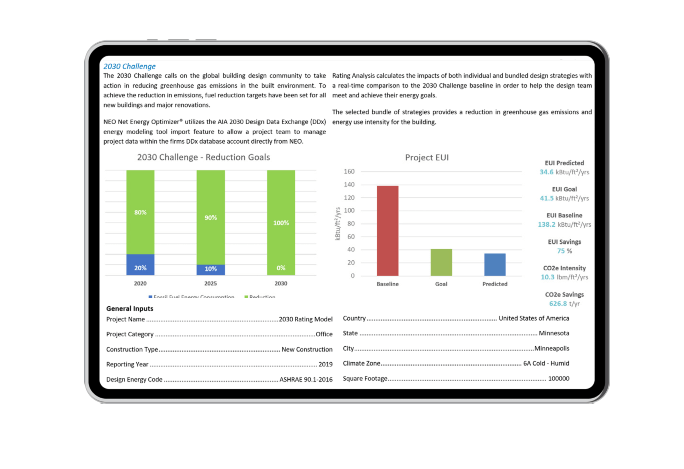
The 2030 Challenge calls on the global building design community to take action in reducing greenhouse gas emissions in the built environment. To achieve the reduced emissions, fuel reduction targets have been set for all new buildings and major renovations with a goal of zero emissions by the year 2030.
However – given the range of building types, local codes, and more stringent annual fuel reduction targets – it can be a daunting task to design a building while keeping all these factors in mind and continue to satisfy your customers requirements and requests. To overcome these challenges, we have created a “2030 analysis” specifically designed to simplify the process of designing and reporting a building that can, cost effectively, meet and exceed the 2030 Challenge requirements.
Step 1. Start by Entering the Basic Parameters of Your Project.
To inform NEO of your buildings 2030 target EUI, select the 2030 reporting year for your building. Next, follow NEO’s guided process to enter your design characteristics – starting with the building definition – followed by defining your HVAC systems. Then, get your results with a simple click of a button – NEO performs the energy simulations and presents you with a bundled menu of common cost-effective measures that are customized for your building.


Step 2. Review the Initial Bundle of Measures.
If desired, simply refine your design by adding, removing, or editing the measures in order to explore the tradeoffs between energy, cost, and environmental factors as you work to achieve a high performing, low cost building that ensures you reach your 2030 target. The Results Dashboard in the user interface highlights NEO’s real-time modeling approach by allowing you to track how the building design is performing against the target as changes are made.

Step 3. Share the Results with the Building Owner.
Everyone likes a success story, and with NEO’s dynamic report building feature you can add a 2030 analysis appendix to the Results Report. Document the environmental contribution that is a direct result of the decisions that the building owner has made towards reducing their fossil fuel consumption and combating climate change.
 Step 4. Share the Results with the Design Community.
Drive change and elevate the work of your firm by uploading your modeling details directly to your DDx account, NEO makes it easy. Let NEO help you fulfill your firm’s internal sustainability goals and make it easier for your future customers find you based on your success.

You don’t have to be a big firm to make a big difference. Whether you work on one building or one hundred buildings – let NEO help you fulfill your 2030 challenge commitment – keeping your New Year’s resolution has never been easier!

by dwolfwilldancom | Oct 1, 2020 | Validated, Versatile
The Data You Need, When You Need It Most
Managing multiple energy modeling platforms is time consuming, costly, and can confuse customers. NEO Net Energy Optimizer® provides customized, real-time energy and financial return on investment analyses in minutes. NEO expands on the traditional energy modeling platform to leverage automation and industry-standard inputs while providing you with the versatility to model more than 40 different building types and over 150 unique HVAC systems. Whether your project is new or existing construction let NEO do the work for you.
The Right Data
Data entry errors are a thing of the past: NEO supports your new construction project by using vetted, industry-standard inputs to automatically create your whole building model. The software references the user-selected ASHRAE 90.1 or IECC standard from an available codes library, which spans across multiple years – this allows you to simulate projects virtually anywhere in the world and under any jurisdiction. Users define the building location, architectural, electrical, and HVAC characteristics specific to the project – then NEO uses location services to automatically retrieve and apply the local weather file based on the building address – it creates the baseline automatically and simulates hundreds of energy conservation measures specific to your project. With NEO’s automated modeling approach – you can feel confident that you’re getting validated results in minutes with the accuracy of models that can take hours or days to develop.
Choose from a number of different baseline energy standards to model your project virtually anywhere in the world and under any jurisdiction.
The Right Time
Watch your model evolve: For customers, consistency and timing matter – with NEO you can quickly and easily bring forward a design model and convert it into an existing building model. The user can simply select “Existing Building” for the construction type and NEO will automatically create an existing building baseline for comparison in minutes. If you have it – you can even customize the model by adding utility bill information and updating the operational conditions to dial in the model. These automated features allow owners to confirm the energy savings that were forecast in design and validate the decisions that were made to achieve those savings, while also increasing the efficiency for the NEO user by ensuring consistent results and reducing the amount time and cost required to perform an analysis. Because the model evolves with the project, it provides the versatility needed to meet and exceed the many unique modeling challenges for designers, manufacturers, and operators within the industry.

Perform an audit of an existing facility and customize the model to align with existing utility bill data.
The Right Results
You can’t manage what you don’t measure: Stakeholders are often faced with making critical energy, environmental and financial decisions in short timelines with minimal information. With evolving construction technology, more stringent building codes and limited project resources, the impact of these decisions continues to grow. NEO helps drive increased efficiency, reduces dependency on fossil fuels, and promotes new technologies by giving stakeholders performance based answers to their complex product selection, building audit or new construction design decisions. NEO provides the hard data needed to prove the energy, environmental and financial value of the decision at hand; helping overcome the potential sticker-shock of a new technology or influencing a team to move away from “doing it how it’s always been done.” As the NEO user becomes a more educated consumer, supplier or consultant, a circular feedback loop influences: designers to build more efficient buildings; operators to run them optimally; and equipment manufacturers to build more efficient systems to meet market demand.

NEO’s validated results help designers, owners, and manufactures make faster more informed decisions so they can construct and maintain higher-performing buildings.
NEO Net Energy Optimizer® helps stakeholders to make faster, more informed decisions with trusted data you can build on.

by dwolfwilldancom | Sep 1, 2020 | Fast, Validated
Life-Cycle Cost Analysis – Trusted Data When You Need It Most
In an ideal world, project budgets would accommodate premium designs, and the best equipment would be the most affordable. However, high efficiency equipment generally comes with a higher price tag, limiting the options a stakeholder considers for their building.
Project designs evolve at a fast pace and decisions are often made based on incomplete information – when accurately communicating equipment benefits to a decision maker in a short amount of time matters – NEO Net Energy Optimizer’s Life-Cycle Cost Analysis produces validated results in real-time, and presents a comprehensive understanding of the equipment selection, beyond first cost alone.
Define Your Equipment
When performing a NEO Life-Cycle Cost Analysis, stakeholders can choose from hundreds of HVAC system and equipment options that leverage trusted industry standards or custom user defined performance characteristics. The user can simultaneously compare multiple HVAC options in minutes resulting in reliable, validated data.


Customize Financial Parameters
Financial inputs provide the user default financial estimates derived from RS Means. If desired, the default financial parameters can be fully customized for both the equipment and the study itself to focus the analysis on the client’s priorities.

Financial inputs include – among other things – life cycle length, interest rates on capital, inflation rates, and depreciation methods.

Equipment study inputs include first cost, maintenance cost, replacement cost, and equipment life.
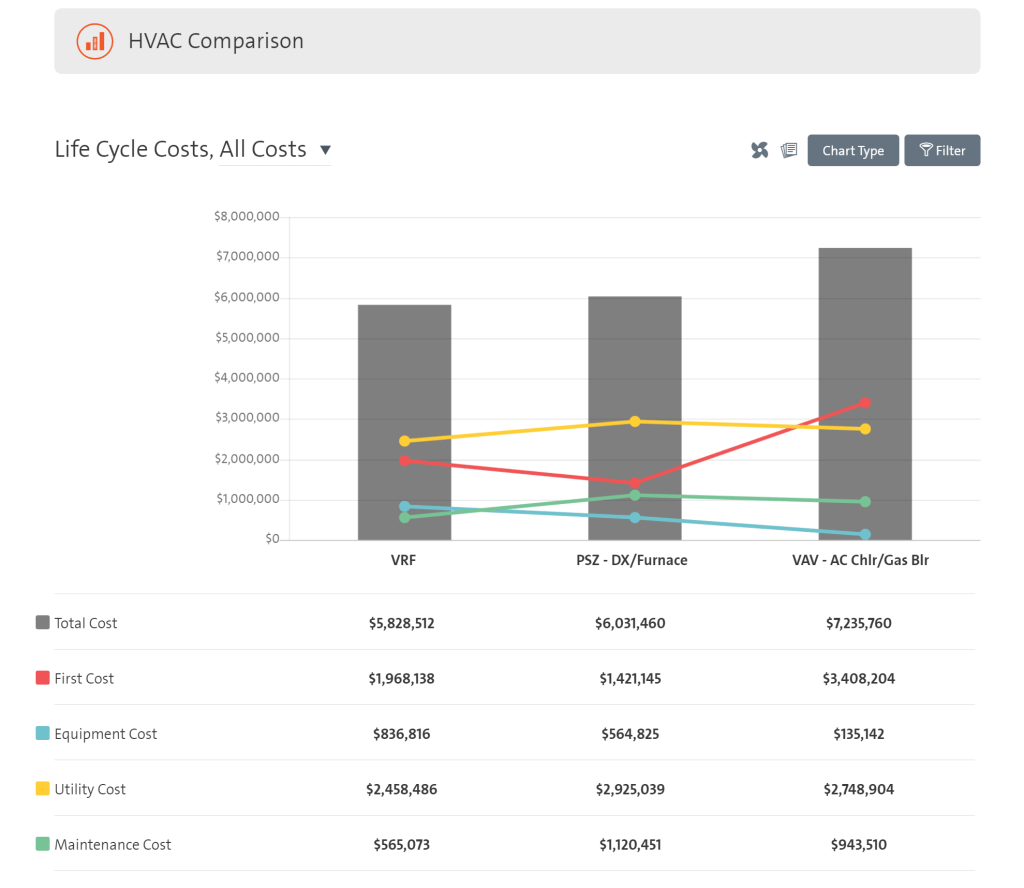
Life-Cycle Cost Comparison
Choosing the best system for a facility is a balancing act between short- and long-term costs, savings, and energy goals. Users can create a sideby-side comparison to review the analysis and determine tradeoffs. This provides energy savings and ROI information in real-time and allows users to choose the most efficient products and design within their budget.
NEO Net Energy Optimizer helps stakeholders to make faster, more informed decisions with trusted data you can build on.
.
